Summary
If you have ever planned an event with more than one type of table, you already know the challenge. Round guest tables, a long rectangular head table, a separate cake table, and a few cocktail tables scattered around the room all need to be covered, and they do not all take the same size tablecloth. The question most people ask is whether mixing different tablecloth sizes will make the whole setup look mismatched or off. The short answer is no, not if you do it right. Mixing tablecloth sizes is not only common at events but often unavoidable. What matters is how you tie everything together, so the overall presentation looks cohesive.
Our Products


Round Tablecloths
Tablecloths
Rectangular Tablecloths
Quick Answer
- Yes, you can absolutely mix different tablecloth sizes at one event
- Different table shapes and functions naturally require different tablecloth sizes
- The key to making it work is consistency in color, fabric, and styling accessories
- Runners, overlays, and napkins are your best tools for unifying a mixed tablecloth setup
- Cohesion comes from the overall look, not from every tablecloth being identical
Mixing tablecloth sizes is very common, especially for events with different table types. Instead of focusing on making every table identical, focus on how everything looks as a whole. Small adjustments can help everything feel more balanced.
Why Events Often Have Different Table Sizes
Most events are not set up with just one type of table, and that is by design. Different tables serve different purposes, and each one typically requires a different size tablecloth to fit properly.
Round tables are the most common choice for guest seating at weddings and banquets. They encourage conversation and fit more guests into a space efficiently. A standard 60” round table seats eight to ten guests and requires a different tablecloth than a rectangular banquet table that seats twenty.
Rectangular tables are typically used for head tables, buffet lines, gift tables, and cake displays. They are longer and narrower than round tables, which means the tablecloth sizing is completely different. A head table at a wedding might be 8 feet long, while the guest tables are all round, and both need to be covered cleanly.
Cocktail tables, also called high-top tables, are a staple at cocktail hours and networking events. They are smaller in diameter and taller than standard dining tables, which means they need their own specific tablecloth size to drape correctly.
Cake tables and gift tables are usually smaller rectangular or round tables that sit off to the side. They still need to be styled consistently with the rest of the room, even though they serve a completely different function.
All these tables in one room mean multiple tablecloth sizes, and that is completely normal.
Can You Mix Different Tablecloth Sizes?

Yes, and most events do exactly that. The idea that every tablecloth at an event needs to be the same size is a common misconception. What matters is that every table looks like it was styled with intention, regardless of its size or shape.
Problems arise when tablecloth sizes are mixed without a plan. If the round guest tables have a floor-length drop and the head table has a short drop that barely covers the edges, the inconsistency becomes noticeable. The issue is not the different sizes; it is the inconsistent drop length and styling that make the setup look unplanned.
The fix is simple: decide on a consistent drop length and styling approach across all your tables, even if the actual tablecloth dimensions are different. When the drop length, fabric, and color are consistent, the different sizes become less noticeable, and the overall setup looks unified.
How to Mix Tablecloth Sizes Without It Looking Off

The secret to mixing tablecloth sizes successfully is creating visual consistency through color, fabric, and accessories. Here is how to do it.
Stick to a consistent color palette. This is the single most effective way to unify tables of different sizes. When all your tablecloths are in the same color or within the same color palette, the eye reads the room as cohesive, even if the tables are different shapes and sizes. Ivory, white, and champagne are popular neutral choices that work across all table types. If you want to add color, keep it consistent across all tables rather than mixing colors between table types.
Use the same fabric across all tables. Fabric consistency is just as important as color consistency. If your round guest tables are covered in a certain fabric, your head table and cake table should match. Same fabric, same color, different sizes, and the room reads as one cohesive setup.
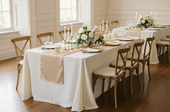
Tie everything together with runners and overlays. Table runners and overlays are one of the most powerful tools for unifying a mixed tablecloth setup. When the same runner appears on the round guest tables, the head table, and the cake table, it creates a visual thread that connects every table in the room and adds texture and dimension to the overall setup.
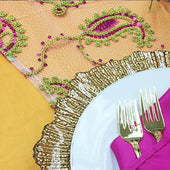
Match your napkins, accessories, and other linens across all tables. Napkins, charger plates, utensils, drapes, and chair covers are small details that have a big impact on cohesion. When these elements are consistent across all your tables, the different tablecloth sizes fade into the background completely.
When these elements are consistent across all your tables, the different tablecloth sizes fade into the background completely.
Common Event Scenarios and How to Handle Them
Weddings with round guest tables and a rectangular head table. This is the most common mixed tablecloth scenario at weddings. The guest tables are typically 60” rounds that need a 120” or 132” round tablecloth for a floor-length drop. The head table is usually a 6-foot or 8-foot rectangular table that needs a 90"x156" or larger rectangular tablecloth. To keep the look cohesive, use the same color and fabric for both and add a matching runner down the center of the head table to mirror the runners on the round guest tables.
Banquets with mixed table shapes. Banquet setups often include a mix of round guest tables, rectangular buffet tables, and a separate presentation or head table. The key here is to keep the tablecloth color consistent across all tables and use the same runner or overlay on every surface.
Outdoor events with varying table sizes. Outdoor events often have the most variety in table sizes, from long farm tables to small cocktail tables to round dining tables. For outdoor setups, fabric choice matters even more because wind and weather can affect how tablecloths drape and stay in place. Polyester tablecloths are a practical choice for outdoor events because they are durable, easy to clean, and hold their shape well. Keep the color consistent and use tablecloth clips to keep everything in place, regardless of the table size.
Bringing It All Together
So, can you mix different tablecloth sizes in one event? Yes, you can. It’s actually a common part of event setups.
What matters most is how everything comes together. When the drops look balanced and the colors work well together, the setup will still look clean and organized. You do not need everything to match exactly. It just needs to feel cohesive.
Frequently Asked Questions
Can you use different tablecloth sizes at the same event?
Yes. Most events have multiple table types that require different tablecloth sizes. The key is to keep the color, fabric, and styling consistent across all tables so the overall look feels cohesive.
Do all tablecloths at a wedding need to match?
They do not need to be identical, but they should be consistent in color and fabric. Using the same ivory or white polyester tablecloth in different sizes for round and rectangular tables is a simple way to keep everything looking unified.
How do I make round and rectangular tables look cohesive?
Use the same color and fabric for both table types and add a consistent styling element like a table runner or overlay across all tables.
What tablecloth size should I use for different tables?
Choose sizes based on the table dimensions and your preferred drop. Different tables may require different sizes, and that’s normal.
What is the best way to unify tables of different sizes?
Consistency in color, fabric, and accessories is the most effective approach. Choose one tablecloth color and fabric and use it across all your tables in the appropriate sizes. Add matching runners, napkins, and charger plates to every table to create a unified look throughout the room.