Summary
The right curtain width is your window's width multiplied by 1.5 to 2, which gives the fabric enough fullness to look intentional rather than flat and stretched when closed. This same math applies whether you're measuring a home window or an event pipe-and-drape backdrop, since both need extra fabric width to hang with proper folds instead of pulling taut. This guide walks through the exact calculation, how to size your curtain rod, how to measure length, and the most common mistakes to avoid.
Our Products


Quick Answer
To measure curtain or drape width, measure your window's width from outer frame edge to outer frame edge, then multiply that number by 1.5 to 2 for a standard full look, or by 2 to 2.5 for an especially lush, gathered look. A 48-inch window needs 72-inch-wide curtains at the 1.5x ratio, or 96-inch-wide curtains at the 2x ratio. The same multiplier applies to event drapes and pipe-and-drape backdrops, where wider fabric creates the same full, upscale appearance. Browse the full pipe and drape sets collection to see event drape widths sized using this same ratio.
How to Calculate Curtain Width, Step by Step
Step 1: Measure Your Window's Outer Frame Width
Measure from the outer edge of one side of the window frame to the outer edge of the other side, not just the glass itself. Keep your tape measure level and straight across, since a slanted measurement will throw off every calculation that follows.
Step 2: Multiply by 1.5 for a Standard Look
Multiply your window's width by 1.5 to get the curtain width for a standard, moderately full look. A 48-inch window calls for 72-inch-wide curtains at this ratio (48 x 1.5 = 72).
Step 3: Multiply by 2 to 2.5 for a Fuller Look
For a noticeably fuller, more luxurious drape, multiply your window's width by 2 to 2.5 instead. That same 48-inch window would need 96-inch wide curtains at the 2x ratio (48 x 2 = 96), or 120-inch wide curtains at the 2.5x ratio (48 x 2.5 = 120).
Step 4: Size Your Curtain Rod to Extend Past the Window
Add 3 to 6 inches of rod length on each side of the window for a smaller space, or 4 to 6 inches on each side for a larger one, so the curtains can be drawn fully open without covering any of the window itself. A wider rod also makes the window appear larger, which is part of why this step matters as much as the fabric width.
Step 5: Confirm Your Fabric Choice Matches Your Width Calculation
Thicker, heavier fabrics hold their shape with fewer folds, while thinner fabrics need more width to achieve the same full look. If you're using a pleated or ruffled heading, factor that style into your width as well, since both add visual bulk beyond the flat fabric measurement.
How to Measure Curtain Rods
Getting curtain rod length right matters just as much as the fabric width, since a rod that's too narrow forces curtains to cover part of the window even when fully open.
As a general rule, use a rod that's wider than your window on both sides. For smaller spaces, 3 to 4 inches of extra width per side is usually enough. For larger spaces, 4 to 6 inches of extra width per side gives the curtains more room to stack neatly to the sides when opened.
This same principle applies directly to event drapes and pipe-and-drape backdrops. Wider drape panels create a fuller, more upscale look at a party or reception, the same effect a wider curtain rod creates at home. The pipe and drape accessories collection includes crossbar supports and other hardware sized to hold wider drape panels securely in place.


Measuring Drape Length
Once your width is set, length is the next measurement that determines the overall look. Standard curtain lengths typically come in 63, 84, 108, and 120 inches, so measuring your window's height first helps you choose the closest standard size or confirm you need a custom length.
Measure from the top of the window frame (or your installed rod, if already mounted) down to where you want the curtain to end. For a classic floor-length look, the curtain should hang just above the floor. For a more dramatic, luxurious "puddle" effect, add an extra 6 to 12 inches beyond the floor measurement so the fabric pools slightly at the bottom.
Choosing a Curtain Break
The curtain break is where your drape ends relative to the window or floor, and it changes the overall formality of the look:
- Above-sill break: Curtains end just above the windowsill, for a casual, simple look.
- Below-sill break: Curtains extend about 6 inches (15 cm) past the sill, for a slightly more polished feel while staying casual.
- Floor-length break: Curtains hang just above the floor, for a clean, classic look.
- Puddle break: Curtains pool on the floor by 6 to 12 extra inches, for a more dramatic, luxurious effect.
If your rod is already mounted, measure directly from the rod to your desired break point rather than from the window frame, since the two measurements can differ once hardware is installed.
Common Mistakes to Avoid When Measuring Drape Width
- Measuring only the glass, not the frame. Always measure from the outer edge of the window frame or molding to get accurate coverage.
- Using a rod that's the same width as the window. This leaves no room to draw curtains fully open without blocking part of the window.
- Ignoring fabric weight. Thinner fabrics need more width to look full; thicker fabrics need less. Using the same width for both produces inconsistent results.
- Forgetting the curtain heading style. Pleats and ruffles add visual width beyond the flat fabric measurement, so account for them before finalizing your order.
- Measuring at an angle. A slanted tape measure throws off every calculation that follows, so keep it level and straight across.
Coordinating Your Drapes With the Rest of the Event
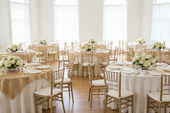
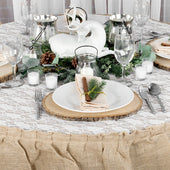
For event spaces specifically, drapes and backdrops rarely stand alone; they usually frame a room that includes dressed tables as well. Carrying the drape's color palette down to the tables helps the whole space read as one cohesive design. A tablecloth in a complementary tone gives the room a consistent base to build on. Browse the tablecloths collection to find a shade that pairs with your drape color.
A table runner adds a second layer of texture that can echo an accent from the drapery, such as a metallic or sequin finish, without requiring an exact match. The table runners collection includes finishes that work well against colorful or textured backdrops.
At each place setting, charger plates and napkins carry a smaller accent color from the drapes down to the table itself. The charger plates and napkins collection includes options suited to both casual and more elevated events.
A centerpiece rounds out the connection between the drapes and the tables, especially when it repeats a color or texture from the backdrop. The centerpiece collection includes floral, candle, and crystal options that can echo a drape's palette without duplicating it exactly.
Bringing the Measurements Together
Getting curtain or drape width right comes down to one core calculation: your window's width multiplied by 1.5 to 2 for a standard full look, or 2 to 2.5 for a fuller one. From there, sizing the rod to extend past the window, choosing a length that matches your desired curtain break, and accounting for fabric weight and heading style round out a measurement process that applies equally to home windows and event drape backdrops.
Frequently Asked Questions
What is the general rule for curtain or drape width?
Take your window's width and multiply it by 1.5 to 2 for a standard full look, or by 2 to 2.5 for an especially full, luxurious look.
What size curtains do I need for a 48-inch window?
At the standard 1.5x ratio, a 48-inch window needs 72-inch-wide curtains. For a fuller look at the 2x ratio, you'd need 96-inch-wide curtains.
What size curtains do I need for a 72-inch window?
At the standard 1.5x ratio, a 72-inch window needs 108-inch-wide curtains. At the fuller 2x ratio, that becomes 144 inches wide.
How far should a curtain rod extend past the window?
A curtain rod should typically extend 3 to 4 inches past each side of the window in smaller spaces, or 4 to 6 inches past each side in larger spaces, so curtains can be drawn fully open covering the window.
Does the same width rule apply to event drapes and pipe-and-drape backdrops?
Yes. The same 1.5x to 2x multiplier that applies to home curtains also applies to event drapes, since wider fabric panels create the same full, upscale look at a party or reception that they do on a window at home.
How much should curtains puddle on the floor?
For a puddle effect, add 6 to 12 extra inches beyond your floor-length measurement so the fabric pools slightly at the bottom rather than hanging straight to the floor.