Summary
Repetition is the design principle that makes a room feel designed rather than decorated. When the same color appears in the tablecloth, the chair sash, the backdrop draping, and the napkin, the eye reads those four separate elements as part of a single intention. When each element is a different color chosen independently, the eye reads them as four separate decisions, and the room feels assembled rather than cohesive. Repetition is not sameness. It is the deliberate recurrence of a color, a fabric, or a form across multiple elements so the design language reads consistently from every position in the room.
This guide covers how to apply repetition across color, fabric, and form using velvet tablecloths, satin chair sashes, table runners, sheer draping, charger plates, and napkins from CV Linens™.
Our Products


Quick Answer
- Repetition is the deliberate recurrence of a color, fabric, or form across multiple elements of the room.
- Repeat the dominant color at a minimum of three points in the room: the tablecloth, the chair sash, and the backdrop or draping.
- Repeat the metallic accent at every reflective surface: charger plates, candle holders, and flatware.
- Repeat the fabric texture at two scales: a large-scale element like the tablecloth and a small-scale element like the napkin.
- Repeat the tie style on every chair sash in the room. Variation in tie style reads as inconsistency rather than intentional contrast.
Why Repetition Creates Cohesion

Cohesion in event design is the perception that every element in the room belongs to the same visual language. Repetition creates that perception by giving the eye a pattern to recognize. When the eye encounters the same color, fabric, or form more than once, it registers a pattern. When it encounters that pattern a third time, it reads the room as designed.
The minimum threshold for repetition to register as intentional is three occurrences. A color that appears once reads as a choice. A color that appears twice reads as a coincidence. A color that appears three or more times reads as a design decision. The three-zone approach: room level, table level, and seat level, is the most reliable framework, and is the most reliable framework for building cohesion. It guarantees that the dominant color appears at least three times in the guest's field of view simultaneously.
The risk of repetition is monotony. A room where every element is identical in color, texture, and form reads as uniform rather than cohesive. The solution is to repeat the color while varying the fabric, or repeat the fabric while varying the scale. Repetition with variation is what produces cohesion. Repetition without variation produces uniformity.
Repeat Color Across Three Zones

The most important application of repetition in event design is color. The dominant palette color should appear at a minimum of three points in the room simultaneously so the eye can register it as a pattern rather than an isolated choice,
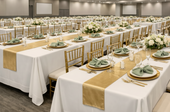
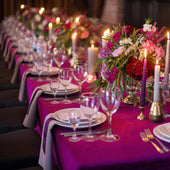
The three zones are room level, table level, and seat level. At the room level, sheer voile curtain drape panels in the dominant color or in ivory hung behind the head table or along the venue perimeter introduce the color at the largest scale. At the table level, a velvet tablecloth in the dominant color establishes it at the surface where guests spend most of their time. At seat level, satin chair sashes in the dominant or coordinating color carry it into the vertical space and create a visual rhythm across the room that reads as intentional from every angle.
When the same color appears in all three zones simultaneously, the room reads as a single designed environment. When any zone is missing, the color story feels incomplete regardless of how well the other two zones are executed.
Repeat the Metallic Accent at Every Reflective Surface

The metallic accent, gold or silver, is the element that most benefits from consistent repetition because it appears on multiple small-scale elements simultaneously and creates a visual rhythm at the tabletop level that reads as polished and intentional.
Gold charger plates at every seat introduce the metallic element at the place setting level. Gold candle holders on the centerpiece repeat it at the table's center. Gold flatware repeats it at each seat. When the same metallic finish appears on every reflective surface at the table, the place setting reads as fully designed rather than partially styled.
The rule is that the metallic finish should never vary within the same table. A gold charger plate with silver flatware reads as an oversight. A gold charger plate with gold flatware and gold candle holders reads as a deliberate design decision. The repetition of the finish is what creates the intentional quality.
Repeat Fabric at Two Scales

Fabric repetition creates cohesion through texture rather than color. When the same fabric type appears at two different scales on the same table, the eye reads the recurrence as intentional, and the table reads as more designed than a table where each element uses a different fabric.
The most effective fabric repetition pairs a large-scale element with a small-scale element in the same fabric family. A velvet tablecloth at the large scale, paired with a velvet napkin ring or velvet ribbon accent at the small scale, creates a fabric repetition that reads as deliberate. A satin runner at the large scale, paired with polyester napkins in a coordinating satin-finish fabric at the small scale, creates the same effect.
Table runners are the most versatile tool for fabric repetition because they sit between the tablecloth and the place setting in both scale and position. A runner in the same fabric family as the tablecloth, velvet on velvet or satin on satin, creates a tonal repetition that reads as intentional layering. A runner in a contrasting fabric, sequin on velvet or sheer on polyester, creates a texture contrast that makes both fabrics more visible through their difference.
Repeat Form in Chair Treatments

Form repetition is the most overlooked application of repetition in event design and the one that most directly communicates professionalism and attention to detail. Form repetition means executing the same tie style, the same fold, or the same arrangement consistently across every identical element in the room.
A satin chair sash tied in a classic bow on every chair in the room creates a visual rhythm that reads as intentional from across the space. The same sash tied in a different style on every third chair reads as an inconsistency. The color is the same. The form is not. And the inconsistency in form is what the eye notices.
Develop two or three tie styles that you execute consistently and that photograph well from a distance. Apply the same style to every chair in the room without variation. The consistency of form across a large number of chairs is one of the most powerful applications of repetition in event design because it creates a pattern that reads at room scale and communicates that every detail was intentional.
Final Thoughts
Repetition is the design principle that turns individual decor choices into a cohesive event. Repeat the dominant color in three zones. Repeat the metallic accent at every reflective surface. Repeat the fabric at two scales. Repeat the tie style on every chair. Each application of repetition reinforces the others and produces a room that reads as designed from every position. CV Linens™ carries the velvet tablecloths, satin chair sashes, sheer draping, gold charger plates, table runners, and polyester napkins needed to build that repetition consistently across any event setup.
Frequently Asked Questions
What is the difference between repetition and monotony in event design?
Repetition is the deliberate recurrence of a color, fabric, or form with variation in at least one other dimension. Monotony is repetition without variation. A room where the dominant color appears in the tablecloth, the chair sash, and the backdrop draping uses repetition because the color is consistent, but the fabric and scale vary. A room where every element is identical in color, fabric, and scale reads as monotonous.
How many times does a color need to appear to read as intentional?
Three is the minimum threshold. A color that appears once reads as a choice. A color that appears twice reads as a coincidence. A color that appears three or more times reads as a design decision. The three-zone approach, room level, table level, and seat level, guarantees that the dominant color appears at least three times in the guest's field of view simultaneously.
Does the chair sash tie style really matter for cohesion?
Yes. Form repetition is one of the most powerful applications of repetition in event design because it creates a pattern that reads at room scale. A satin chair sash tied in the same style on every chair creates a visual rhythm that reads as intentional from across the space. Variation in tie style across the same room reads as inconsistency even when the color is identical.
How do I repeat fabric without making the table look monotonous?
Repeat the fabric at two different scales rather than two identical elements. A velvet tablecloth at the large scale paired with a velvet accent at the small scale creates fabric repetition with scale variation. Alternatively, repeat the color in the same fabric family while varying the texture. A satin runner on a polyester tablecloth creates tonal repetition with texture contrast.
Should the metallic finish be the same across every element on the table?
Yes. The metallic finish should never vary within the same table. A gold charger plate with silver flatware reads as an oversight. A gold charger plate with gold flatware and gold candle holders reads as a deliberate design decision. The consistency of the metallic finish across every reflective surface is one of the simplest ways to make a place setting read as fully designed.